


Controlled transactions are actually quite common, even if this is the first time you are hearing about them.
And in our experience, more companies have controlled transactions than those that do not.
In this post, we will take a closer look at controlled transactions, find out what they are, and how you should handle them for tax purposes.
What are controlled transactions?
A controlled transaction is a transaction between two companies or between an individual and a company, where one party has controlling influence over the other.
Did that sound like a language you just didn't understand?
If so, we completely understand. So, let's try to break it all down.
The key to controlled transactions lies in whether one party has "controlling influence" over the other.
Controlling influence is tax terminology for someone who owns more than 50% of the capital or voting rights in a company. If this person has transactions with the company where the capital is held, it is a controlled transaction.
This means that if you own an operating company and a holding company, and the operating company rents space in the holding company's building, a controlled transaction occurs when rent is transferred.
It is also a controlled transaction if you rent out your private backhoe to perform work for a client through your company.
Another type of controlled transaction can involve expenses. If you are in doubt about whether a given transaction falls into this category, you are always welcome to ask our accountants in the chat.
Why are controlled transactions important?
A transaction is a transaction. You can usually just shrug those off and move on. But that is not quite the case with controlled transactions.
This type is subject to mandatory disclosure, which means you must report them to the tax authorities. If you fail to report them, you risk being fined.
There are also other types of controlled transactions, such as salary and dividends, but these are not subject to mandatory disclosure.
Typical controlled transactions that must be reported:
- Transfer of rent between you and/or your operating and holding company
- Miscellaneous expenses
- Renting out privately owned assets to your company
Controlled transactions that do not need to be reported:
- Salary payments
- Dividend payments
- Company car or phone
Controlled transactions and the Danish Tax Agency
As mentioned above, you are required to disclose your controlled transactions to the Danish Tax Agency.
You must do this using form 04.021 on your personal tax return and on your company's tax return.
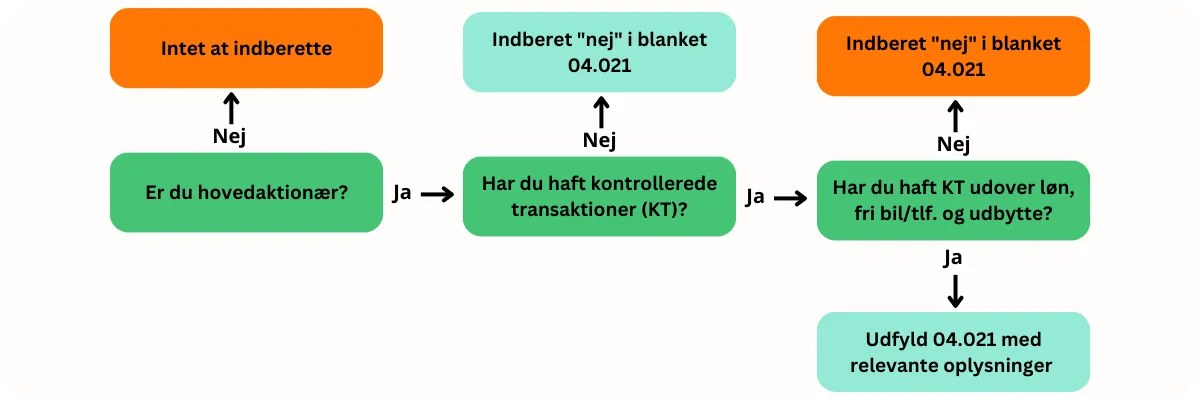
When you own more than 50% of the capital in a company, you are a principal shareholder. As a principal shareholder, you must always complete form 04.021. How much you need to fill out depends on whether there have been controlled transactions and whether they are subject to the disclosure requirement.
This means that a "no" is sufficient if there have been no reportable controlled transactions between you and the company.
We have illustrated this in the image above.
But let's take it a step further and assume you have both an operating company and a holding company, with controlled transactions occurring between you and both companies. In that case, you must disclose the transactions on form 04.021 and on your companies' tax returns.
If, for example, controlled transactions have only taken place between your companies, you only need to report them on the companies' tax returns. However, it is important to remember that you must still check "no" on form 04.021.
To report controlled transactions for your companies, you must, among other things, mark field 067 with a "yes," which will then open a series of other fields that you need to address.
The fields that appear correspond to form 05.021, which we often receive questions about. Form 05.021 whether controlled transactions have been incorporated into the tax return.
Controlled transactions for spouses
We sometimes see married couples who own shares in companies that together exceed 50%. For example, this could be a couple where one spouse owns 37% of a company's shares, while the other owns 14%. In such a case, you add the couple's ownership shares together to reach 51%, meaning they exercise controlling influence together.
This means, in line with the rules above, that they must also report controlled transactions.
Get help with reporting controlled transactions
At Reportability, you can create your annual report yourself using our online tool. In 5 simple and short steps, you go through a process that automatically generates an annual report for you.
When you are finished, you submit your annual report to the Danish Business Authority with a single click. At the same time, you also receive a complete guide to reporting your taxes.
It tells you exactly what you need to do regarding tax. This also includes the controlled transactions you have read about here.
If you have questions along the way, you can always get help from our accounting-savvy staff in the chat.