


Joint taxation is another term for consolidated taxation. In general, it means that a holding company with one or more subsidiaries forms a group and is usually required to settle taxes as a single entity. In other words, you are required to use joint taxation.
But who exactly do these group rules apply to? And when exactly must you use joint taxation?
It is completely understandable that there are many questions about joint taxation, as it is a complex subject to get to grips with.
In this blog post, we will try to answer those questions.
Remember that you can always write or call us if you have further questions about your joint taxation.
Let's get started!
What is joint taxation?
As we touched on briefly, joint taxation is another term for consolidated taxation.
Simply put, this means that if your company is part of a group—i.e., a corporate structure with a parent holding company that controls your company and potentially other underlying companies—all companies are taxed together.
In other words, your company's finances are, for tax purposes, "merged" with the others in the group.
In such a group, it is the parent company that handles the joint taxation and all the associated administrative work.
As mentioned, a parent company is a holding company, and we will take a closer look at its function later in this blog post.
What does joint taxation mean?
We have now established that companies belonging to a group with a parent company must use joint taxation.
But what does this mean for the individual companies and for the group as a whole?
Let's look at an example:
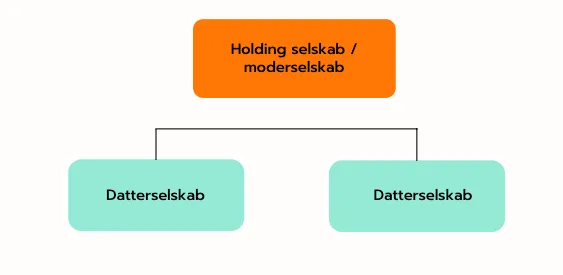
The figure above shows how a jointly taxed group is structured.
The holding company, which is the parent company of a group, has acquired shares in two companies that are now subsidiaries within the group.
This means that the holding company now owns 100% of the two subsidiaries and that the group must be jointly taxed.
This means that if one company has a loss of, for example, -50,000 DKK and the other company has a profit of 100,000 DKK, the profit in one company is "offset" by the loss in the other.
In other words, there is a total result of 50,000 DKK, and the group is therefore only taxed on 50,000 DKK instead of 100,000 DKK, which would have been the case without joint taxation.
If the companies had a combined loss, they could carry that loss forward to future years and offset it against any future profits, just like in the example above, to reduce the tax burden.
Conversely, if all companies in the group are profitable, the total profit for all companies in the group is calculated and taxed accordingly.
Benefits of joint taxation
The example above illustrates the tax advantages of being part of a jointly taxed group.
To put it simply, a jointly taxed group allows the loss from one subsidiary to be deducted from the tax payable by the other companies.
Therefore, you and the other companies in the group utilize the tax loss in one company, thereby paying less in tax.

When are companies in a group subject to joint taxation?
As mentioned earlier, a group subject to joint taxation consists of a parent company and at least one subsidiary.
When discussing parent companies in a group, it usually refers to the company with the most controlling influence over the others, which is typically the holding company. This is because it is the holding company that acquires shares in a company.
As a general rule, if a holding company owns 51% or more of your company, you are part of a jointly taxed group.
And if there are multiple companies in the group where the holding company owns 51% or more, all companies are included in one joint taxation scheme.
Of course, there may be internal agreements, such as a specific shareholder agreement, that mean the holding company does not hold sole controlling influence.
However, this is the exception, and we most often see the holding company in a group acting as the parent/administrative company, with the subsidiaries controlled accordingly.
The parent company
The holding company is the parent company in a group with joint taxation.
And if you are in doubt about what a holding company is and what the rules are for that type of company, then you can read more about it here.
But what can you actually attribute to a parent company, besides the fact that it owns 51% or more of the subsidiaries in the group?
Well, a parent company that belongs to the top-level company in the group can also be called an administrative company.
This means that it is the company responsible for administration and for filing the consolidated tax return for all the jointly taxed companies.
The parent company must therefore ensure
- that all tax payments for the jointly taxed companies are carried out
- that it acts as the contact person for the Danish Tax Agency for all the jointly taxed companies
Furthermore, it is also very important that the parent company ensures that the administrative company is appointed and reported to the Danish Tax Agency.
And this must be done within 1 month of establishing a joint taxation group. You can read more about that here
The subsidiaries
Even though it is the parent company's responsibility to ensure that the group's payments and taxes are in order, the subsidiaries must still complete a tax return containing a statement of their income, which must be reported to the Danish Tax Agency.
Because it is only when all companies have done so that the parent company completes its tax return and fills in field 076, which is the taxable income for all the companies in the group.
Once the subsidiaries have prepared a tax return, they each pay their share of the total tax to the parent company, which is responsible for paying the total tax to the Danish Tax Agency. In this way, you ensure that the Danish Tax Agency receives the correct information, and you avoid ending up with a nasty tax bill or messy paperwork.
Get help from Reportability
There are three ways you can complete the annual reports and tax returns for companies in a group that is jointly taxed.
1. Do it yourself
2. Get help from an accountant
3. Be your own accountant with Reportability's online tool
Doing it yourself is obviously the cheapest solution, but it is also the most time-consuming and risky, as it is easy to overlook something or make mistakes on critical points in your tax return and annual report. This can have costly consequences for the group.
An accountant can also assist with the annual report and tax return, and this is likely the solution that requires the least amount of work from you. On the other hand, it is also the most expensive and resource-intensive option.
The final option is to do it yourself with help and guidance from Reportability. Our tool takes all legislation into account.
All you have to do is follow 5 simple steps, and the tool ensures that you are left with a complete annual report and tax return that you can use with the tax authorities.
We can help you with joint taxation.
Create a free profile right here and get started with your annual reports and joint taxation. You can also read more about our tool for holding companies here.