


If you rent out a property, you must prepare an annual financial statement that forms the basis for your reporting to the Danish Tax Agency. In broad terms, such a statement for your rental activity includes income and expenses, which you simply subtract from one another to determine the amount you need to pay tax on.
In theory, it is a fairly simple matter, but in practice, many landlords find it difficult to figure out which figures should actually be included and exactly how they should be calculated.
In this post, we provide a concrete example of a rental property financial statement and a brief overview of the various line items.
Furthermore, we will show you how you can use our easy tool to manage it yourself without worrying about making mistakes in your calculations and reporting to the tax authorities.
Why is a financial statement important for property rentals?
When you start renting out a property, you are considered a self-employed business owner in the eyes of the Danish Tax Agency from a legal and tax perspective.
In short, this means that your rental activity is considered a form of business.
This leads many to believe that they need to register a CVR number for their rental activity, but as a residential landlord, you are exempt from this.
However, this does not change the fact that you must prepare a financial statement for your rental activity, documenting your income and expenses.
A financial statement is therefore not just "good practice"; it is a necessary part of managing your rental activity correctly.
Documentation for the Danish Tax Agency
In certain cases, the Danish Tax Agency may ask you to document your rental activity, for example:
- during random audits.
- if there are discrepancies in your reporting.
- if the figures deviate from the norm.
- if there is any doubt regarding your deductions.
In such situations, you must be able to present a clear and well-documented set of accounts. If you lack documentation, it can lead to tax reassessments or the loss of deductions.
Your own benefits as a landlord
Proper bookkeeping is not just for the authorities' sake. It is at least as important for you.
Here are the benefits of keeping good records for your property rental:
- You pay the correct amount of tax
- You don't overlook deductions you are entitled to
- You avoid unpleasant surprises on your annual tax statement
- You have an overview of whether your rental is actually profitable
Many landlords lose money every year because they either pay too much tax or forget one or more deduction opportunities. Systematic bookkeeping helps you take full advantage of your rights.
In short: When you rent out a property, you are running a small business. Bookkeeping is the foundation for running it correctly in legal, tax, and personal financial terms.
Example of rental property accounts
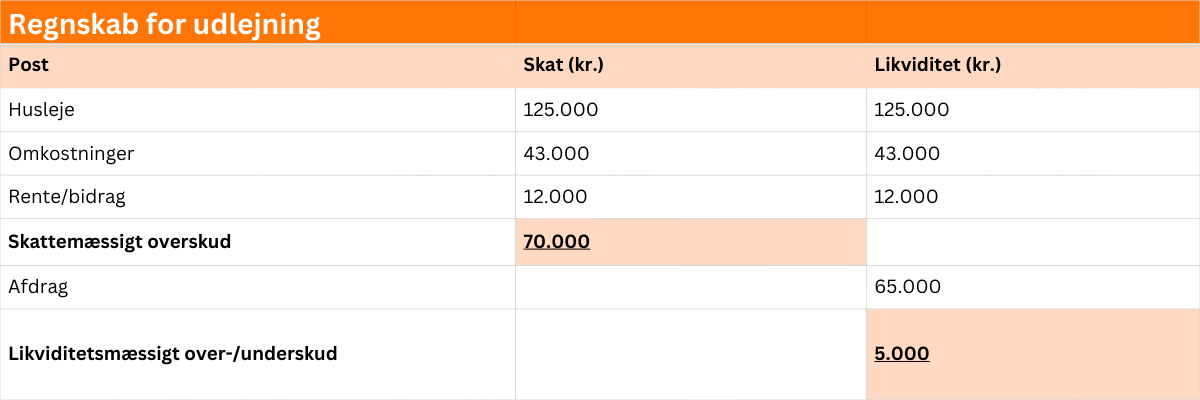
Above, we have created a simple example of accounts for a rental property.
The example shows accounts where the property is rented out for the entire year. This is a standard private rental, and we have rounded and simplified the figures.
Review of the items in the accounts
Let's take a closer look at what the individual items mean.
Rent
Rent is your total rental income for the year.
In the example:
- Annual rent: DKK 125,000.
This is the amount that forms the basis for your tax calculation.
Expenses
Expenses are costs necessary to manage the rental, for example:
- maintenance,
- repairs,
- administration,
- property tax,
- insurance.
In the example:
- Expenses: DKK 43,000.
You can deduct these for tax purposes. It is important to be aware that there may also be other types of expenses that can be included in a standard rental property account.
If you are unsure whether any of your expenses are tax-deductible, you are more than welcome to create an account in our tool, which helps you remember and apply all deductions.
You can also ask a question in our chat support in the bottom right corner.
Interest and fees
You can deduct interest and fees on loans for the property you are renting out. If you use the business tax scheme to calculate your tax, you will receive a higher deduction for your interest than if you use the personal income tax act.
However, this does not apply if you are renting out as a parent purchaser.
In the example:
- Interest/fees: DKK 12,000.
Taxable profit
The taxable profit is one of the most important figures in your accounts because it forms the basis for how much tax you have to pay.
It is calculated as follows:
Rent – Expenses – Interest = Taxable profit
In the example:
- 125,000 – 43,000 – 12,000 = DKK 70,000.
This is the amount you are generally taxed on, regardless of how much money you actually have left in your account.
This means that:
- Tax is calculated based on the profit
- Not based on your actual cash flow
- And not based on how much you have spent on loan repayments
This surprises many new landlords. They may find that there is almost no money left, yet they still have to pay tax on a relatively large profit.
Therefore, it is important to understand that taxable profit and cash flow profit are not directly linked.
Loan repayments
Loan repayments are another key point in your accounts that can sometimes be a source of confusion.
When you make a repayment on a loan for your rental property, you are paying down your debt. This is essentially building equity in the property, not an operating expense.
Therefore, the following applies:
- Repayments are not tax-deductible
- Repayments do not affect your taxable profit
- However, they do affect your cash flow
In the example:
- Repayments: DKK 65,000
Even though you have a taxable profit of DKK 70,000, the majority of it goes toward loan repayments. This helps explain why there is only DKK 5,000 left in cash flow.
Repayments are not "bad money," however. They increase your equity and strengthen your finances in the long run. But in the short term, they can put a strain on your finances if your profit is low.
For this reason, you should always look at taxable profit and loan repayments together when assessing whether your rental property is financially sustainable.
Cash flow result
Cash flow shows how much money you actually have left.
Calculation:
Income – Expenses – Repayments = Cash flow
In the example:
- 125,000 – 43,000 – 12,000 – 65,000 = DKK 5,000
In this example, there is 5,000 DKK left, even though the taxable profit is 70,000 DKK.
This is an important distinction to be aware of as a landlord.
Tax and reporting
Once you have completed your accounts, you must report the figures to the Danish Tax Agency (Skattestyrelsen). You do this on your tax return by entering the figures into the various fields relevant to your rental activity. These fields can be found under the heading "business information" (virksomhedsoplysninger).
It is important to report the figures correctly, as errors can lead to tax arrears, missed deductions, or an audit of your accounts.
If you use our tool to calculate your property rental, you get:
- an accurate calculation of your figures,
- the opportunity to take advantage of all the benefits of the tax schemes,
- help finding all the deductions you are entitled to,
- a complete guide on how to report on Skat.dk.,
- help from our experienced accounting staff in the chat.
Why spreadsheets are rarely enough
Many people start with a spreadsheet, and that can work perfectly fine in the beginning. However, it can cause problems when:
- the rules change
- special schemes are used
- reporting becomes more complex
If you use a tool like Reportability, you don't need to worry about keeping up with new legislation, calculations, tax schemes, or navigating Skat. The tool takes care of everything as long as you enter the figures it asks for.
Automate your accounting with Reportability

At Reportability, we have developed a tool specifically for residential landlords.
The tool helps you:
- automate your accounting,
- calculate tax correctly,
- see exactly which boxes to enter your figures in,
- avoid errors in your tax return.
Unlike the example here, the tool also handles:
- multiple properties,
- special deductions,
- the corporate tax scheme,
- the capital return scheme,
- preliminary income assessments.
Everything in one place.
Frequently asked questions about rental accounting
Do I always have to keep accounts for rental properties?
- Yes. If you have taxable rental income, you must be able to document your figures.
What if I have a loss?
- A loss can often be offset against other income, depending on your situation. However, please note that residential letting must be operated with the intention of making a profit. You therefore cannot set a low rent.
Can I do the accounting myself?
- Yes, but many choose a tool to avoid errors and save time.
Summary: Example of accounting for residential letting
Accounting for residential letting should as a minimum show:
- rental income,
- expenses,
- interest,
- taxable profit,
- cash flow.
Our example shows that a high profit does not necessarily mean a lot of money in the account.
If you want to be sure that your accounting and reporting are correct, a specialized tool can be a great help.
Do you want to see what your own accounting could look like in practice?
Try Reportability and get a full overview of your residential letting.