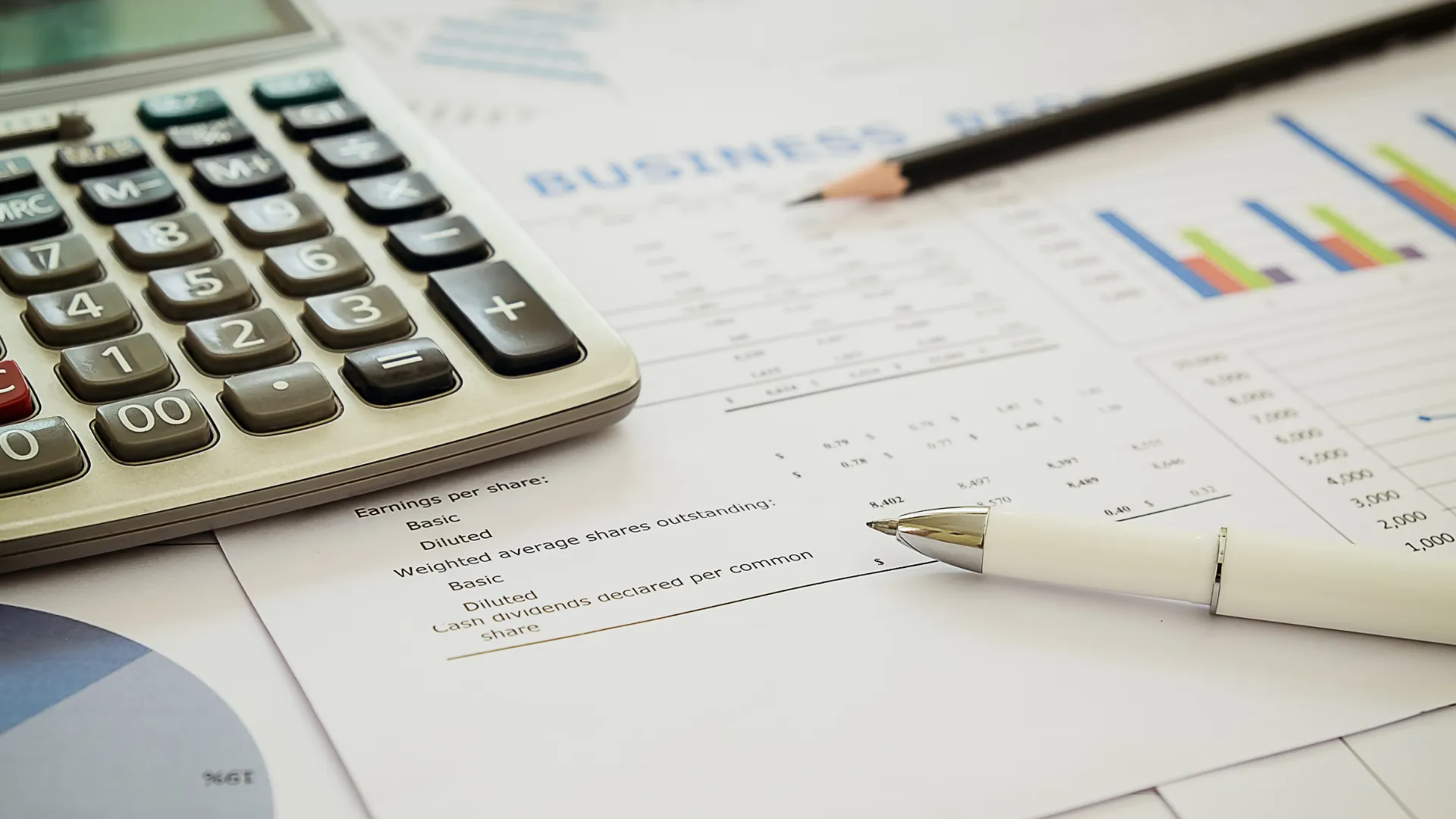


The annual report is the grand culmination of a full financial year of hard work, where you have strived to position your company for a strong result.
It is a summary of all your figures for a financial year and thus serves as an account of your company's finances and any progress made.
Requirements for the content of the annual report
The Danish Financial Statements Act stipulates that companies in reporting classes B, C, and D are required to prepare and file an annual report with the Danish Business Authority. This includes public and private limited companies, listed companies, and state-owned limited companies.
In this blog post, we will review the rules and requirements for the annual report that apply to companies in reporting class B.
If you own a class B company, you must prepare an annual report that consists of at least:
- Statement by the management (if there is more than one member of management)
- Management's review (can also be disclosed in a note)
- Income statement
- Balance sheet
- Notes (including accounting policies)
- Auditor's report, if applicable
You can read more about the requirements for the different reporting classes at the Danish Business Authority.
Can you prepare the annual report yourself?
For most company owners, taking on the task can seem daunting and overwhelming, but it is actually possible to handle the statement by management, the income statement, and the balance sheet yourself.
And even though it sounds like a big task, it will take you no more than 30 minutes to complete.
We have an online tool that automatically sets up your annual report in 5 quick and easy steps. Simply upload your bookkeeping to our tool, answer a few questions, and follow the 5 steps. Once finished, you can submit your annual report to the Danish Business Authority, ensuring full compliance with all legal requirements.
Would you like to give it a try? You can test the tool for free to see if it’s right for you. If you need any help, feel free to message us via the chat in the bottom right corner.
The mandatory annual report
There are a few basic requirements that must be met to create a proper annual report. It is essential that your annual report provides a true and fair view.
First, a true and fair annual report must be clear, ensuring that the information is neither misleading nor ambiguous and cannot be misunderstood.
Second, the information must be "neutral and material." This means that the figures must be accurate, and all relevant matters must be included.
Furthermore, the annual report must contain the items described above, depending on your company structure.
When preparing your annual report, it is also a legal requirement that the cover page includes:
- The title: "Annual Report"
- Company name, CVR number, and address
- Financial year
- Name of the approving body/chairperson
- Date of approval of the annual report
Our tool ensures that you comply with the requirements for your annual report. If you want to read more about the rules for annual reports, you can also read our blog post about the Danish Financial Statements Act.
What can you deduct in your annual report and how?
At the end of the financial year, you need to assess how the items you have acquired during the year should be treated in your annual report. Getting this right can have a significant impact on your company's tax deductions.
You can only claim tax deductions for expenses incurred to secure your company's income. This means acquisitions used for business purposes. You receive these deductions by either deducting the entire amount at once or by spreading it out. Larger acquisitions are spread out, which is known as depreciation.
Not all purchases/acquisitions provide a full deduction, but through tax depreciation, you can ensure that you do not pay more in tax than absolutely necessary.
Examples of common expenses you can claim a tax deduction for
Representation refers to expenses incurred to build business relationships or close a deal, such as restaurant visits and gifts. You are entitled to a 25% deduction for representation.
Small acquisitions are operating assets that cost a maximum of DKK 33,100 (2024 rate). A small acquisition could, for example, be a printer or a mobile phone. You get a full deduction for small acquisitions in the year of purchase – a so-called immediate write-off.
Tangible fixed assets include operating equipment (e.g., a machine), installations, and improvements to rented premises. If the acquisition of the asset exceeds DKK 33,100 (2024 rate), you must spread the expense over a number of years. For operating equipment, you can depreciate a maximum of 25% per year.
Example of depreciation
If you invest in a car for DKK 100,000, you can depreciate 25% in the first year. This means an expense of DKK 25,000 can be deducted from the annual accounts. The following year, you can again depreciate 25% of the remaining balance, i.e., DKK 75,000. Consequently, DKK 18,750 can be deducted from your annual accounts in subsequent years.
At Reportability, you get help with your depreciation so that it is calculated correctly. We ensure that you receive all the tax benefits.
The annual report must be approved
Once you have prepared your annual report, it must be approved before you can submit it to the Danish Business Authority. The approval is carried out by the general meeting at the company's annual general meeting. It is important that it is clearly stated who has approved the annual report.
With the approval, the executive board and the board of directors sign and declare that the annual report is in full compliance with the legislation and provides a true and fair view of the company's finances for the financial year.
The chairperson confirms, and by their signature vouches for the fact, that a general meeting has been held. In addition, the chairperson confirms that all owners/governing bodies have had proper influence and that the annual report has been presented with the opportunity to ask questions.
Is an auditor needed for the annual report?
If the company is subject to an audit requirement, the company's auditor must also sign. All companies, except for partnerships and smaller limited companies, are subject to an audit requirement. This is to ensure that the annual report provides a true and fair view of the finances. So yes, an auditor is needed in that case, but it is not an absolute requirement.
Many small companies choose to opt out of the audit requirement to use the money elsewhere.
Opting out of an audit
It is possible to opt out of the audit requirement and thus the use of an auditor.
For public and private limited companies, it is possible to opt out of the audit requirement if, for at least two consecutive financial years, the company does not exceed two of the following thresholds on the balance sheet date:
- Balance sheet total of DKK 4 million.
- Net revenue of DKK 8 million.
- Average number of full-time employees of 12 during the financial year.
You can also opt out of an audit when you incorporate your company, based on the criteria above. If you wish to do so, the memorandum of association must state that the annual report will not be audited. Furthermore, the articles of association must not contain provisions requiring an audit.
If you opt out of an audit, please be aware that you will be subject to the audit requirement subsequently if two of the three aforementioned thresholds are exceeded at the end of the financial year.
If you wish to opt out of the audit requirement after the first financial year, the decision must be approved at the company's annual general meeting.
If you are subject to an audit requirement, you can choose to include an auditor's report with your financial statements on Reportability.
Create your annual report on Reportability
You can prepare your annual report on Reportability entirely on your own. It takes no more than 30 minutes, and our tool makes you your own auditor.
When you transfer your bookkeeping from your accounting system to Reportability, the tool begins to structure your annual report and calculate your tax. We have integrated all relevant legislation into the tool, so you can comply with it automatically as you go.
Simply answer a few straightforward questions, and you will be finished in no time. If you have any questions or need assistance, you can always get in touch by writing to our auditor in the chat.
You can try the tool for free before you pay, or read more about us by clicking on one of the two buttons below.